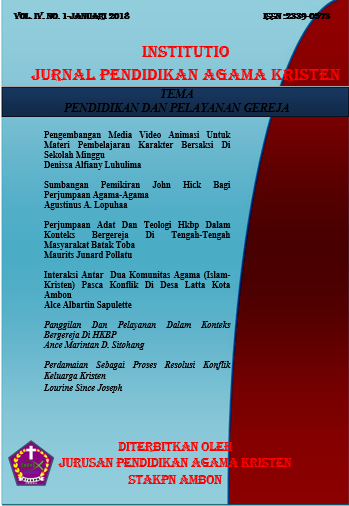
PERDAMAIAN SEBAGAI PROSES RESOLUSI KONFLIK KELUARGA KRISTEN
DOI:
https://doi.org/10.51689/it.v4i1.146Abstract
Peace, tranquility, stability and happiness are the desires of human life, including Christian families. Consciously or not every individual in the life of a Christian family craves such a living situation. However, in fact, conflict is the reason for Christian families living in unhappiness, unease, unhappiness. Love and affection are lost due to the feeling and conviction that emerge as a way of life that is far from peaceful. Inner feelings and wounds outweigh the will of peace, stance exceeds the hope of living peacefully. Peace is one of the ways in the process of conflict resolution over conflicts that occur including Christian family conflicts. The way is through dialogue and communication with love and affection through conversation, dialogue with actions and attitudes, then the Christian family's peace is revealed.
Key words: peace, family conflict
References
Andar Ismail, 2002, Selamat Sejahtera, Jakarta; BPK Gunung Mulia.
Abu Ahmadi, 2010, Psikologi Sosial, Surabaya;Bina Ilmu
Departemen Pendidikan Dan Kebudayaan , Kamus Besar Bahasa Indonesia –edisi ke 3, Jakarta; Balai Pustaka,
Gunaryo Achmad. 2007. Konflik DanPendekatan Terhadapnya, dalam M. Muchsin Jamil, Mengelola Konflik, membangun damai. Semarang; Walisogo, Mediator Center.
I.H.Enklaar dan E.G.Homrighausen, 2011, Pendidikan Agama Kristen, cet ke 25, Jakarta; Gunung Mulia
Jois.A.Rantung. 2017. Resolusi Konflik Dalam Organisasi, Jakarta; BPK.Gunung Mulia,
Robby Candra, 1992, Konflik Dalam Kehidupan Sehari-Hari, Jakarta; Kanisius,
R.M.Drie Brotosudharmo, 2008. PAK Untuk Perguruan Tinggi, Yokjakarta;Andi
Yusuf Asri, 2013, Masyarakat Membangun Harmoni Resolusi Konflik Dan Bina Damai, Jakarta; Pustlitbang Kehidupan Beragama
Downloads
Published
Issue
Section
License
- Seluruh materi yang terdapat dalam situs ini dilindungi oleh undang-undang. Dilarang mengutip sebagian atau seluruh isi situs web ini untuk keperluan komersil tanpa persetujuan dewan penyunting jurnal ini.
- Apabila terdapar beberapa artikel dalam JURNAL INSTITUTIO yang melanggar atau berpotensi melanggar hak cipta yang anda miliki, silahkan laporkan kepada kami, melalui email pada [email protected]
- Aspek hukum terhadap akses setiap informasi dan artikel yang tercantum dalam situs jurnal ini mengacu pada ketentuan lisensi Creative Commons Attribution-ShareAlike (CC BY-SA).
- Semua Informasi yang terdapat di INSTITUTIO bersifat akademik. INSTITUTIO tidak bertanggung jawab terhadap kerugian yang terjadi karana penyalah gunaan informasi dari situs ini