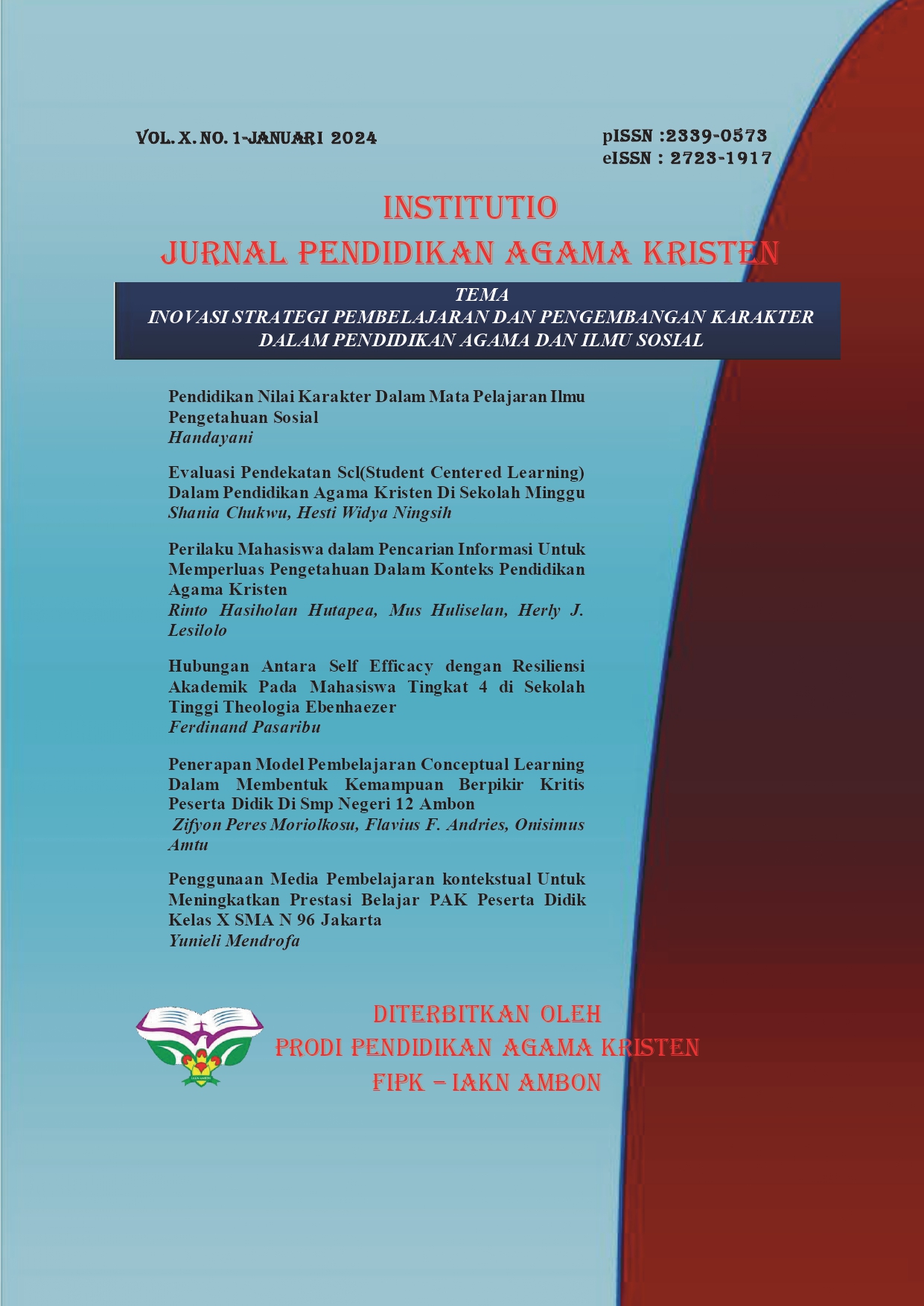
Hubungan Antara Self Efficacy dengan Resiliensi Akademik Pada Mahasiswa Tingkat 4 di Sekolah Tinggi Theologia Ebenhaezer
DOI:
https://doi.org/10.51689/it.v10i1.1251Abstrak
This study aims to investigate the relationship between self-efficacy and academic resilience among fourth-year students at the Ebenhaezer School of Theology. The research employs a quantitative approach with data analysis methods to obtain perceptions or results. By using a quantitative approach and explanatory methods, this study seeks to explain the impact of self-efficacy and academic resilience on the learning process of students. The results indicate a positive and significant relationship between self-efficacy and academic resilience, with a cumulative percentage of 80% in the "strongly agree" and "agree" categories. This research is expected to provide new insights into self-efficacy and academic resilience among students, particularly in the academic environment of the Ebenhaezer School of Theology. In conclusion, there is a significant positive relationship between the two. The author recommends enhancing information on self-efficacy and improving information service media related to self-efficacy and academic resilience.Referensi
Asude Malkoç dan İlhan Yalçin. “Relationships among Resilience, Social Support, Coping, and Psychological Well-Being among University Students.” Turkish Psychological Counseling and Guidance Journal 5, no. 45 (2015): 35–43. https://dergipark.org.tr/en/pub/tpdrd/230060.
Ayu Prastiani, Devy, and Agung Listiadi. “Pengaruh Self Efficacy, Persepsi Profesi Guru Dan Lingkungan Keluarga Terhadap Minat Menjadi Guru Akuntansi Pada Mahasiswa S1 Pendidikan Akuntansi UNESA.” Jurnal Riset Pendidikan Ekonomi 6, no. 2 (2021): 47–59. https://doi.org/10.21067/jrpe.v6i2.5712.
Bandura, A. Self-Efficacy: The Exercise of Control. New York: W.H. Freeman and Company., 1997.
Chemers, M. M., Hu, L., & Garcia, B. F. “Academic Self-Efficacy and First-Year College Student Performance and Adjustment.” Journal of Educational Psychology 93, no. 1 (2001): 55–64.
Fakhriyani, Diana Vidya. “Peran Resiliensi Terhadap Kesehatan Mental: Penyesuaian Psikologis Selama Pandemi Covid-19.” International Conference on Islamic Studies (ICONIS) 19 (2021): 465–76.
Fatmah, Nor, Fakultas Ushuluddin, Dan Humaniora, Uin Antasari, Banjarmasin Hemy, Heryati Anward, and Marina Dwi Mayangsari. “PSIKODINAMIKA : JURNAL LITERASI PSIKOLOGI Efikasi Diri Dan Kepercayaan Diri Mahasiswa PGSD Terkait Kecemasan Berbicara Di Depan Umum” 1, no. 1 (2021): 31–40.
Gusdiansyah, Edo, Program Studi Keperawatan, STIKes Alifah Padang, and Jl Khatib Sulaiman No. “JIK (Jurnal Ilmu Kesehatan) Online Self Efficacy Dan Peran Keluarga Dalam Merawat Pasien Skizofrenia.” Jurnal Ilmu Kesehatan) | Oktober 7, no. 2 (2023): 474–82.
Hardianto, Gusriko, Erlamsyah Erlamsyah, and Nurfahanah Nurfahanah. “Hubungan Antara Self-Efficacy Akademik Dengan Hasil Belajar Siswa.” Konselor 3, no. 1 (2016): 22. https://doi.org/10.24036/02014312978-0-00.
Hertinjung, Wisnu Sri, Susatyo Yuwono, Partini Partini, Andira Koza Laksita, Annisa Ayu Ramandani, and Shafira Sekar Kencana. “Faktor-Faktor Yang Memengaruhi Resiliensi Remaja Di Masa Pandemi.” Proyeksi 17, no. 2 (2022): 60. https://doi.org/10.30659/jp.17.2.60-71.
Husna, Nurul, Luthfi Saiful Arif, and Mardiastuti Wahid. “Hubungan Antara Self-Efficacy Terhadap Prestasi Akademik Pada Mahasiswa Kedokteran Gigi (Tinjauan Pustaka).” Cakradonya Dental Journal 14, no. 2 (2023): 112–21. https://doi.org/10.24815/cdj.v14i2.29954.
Lianto, Lianto. “Self-Efficacy: A Brief Literature Review.” Jurnal Manajemen Motivasi 15, no. 2 (2019): 55. https://doi.org/10.29406/jmm.v15i2.1409.
Manumpak, Joni, Parulian Gultom, Martina Novalina, Andries Yosua, Sekolah Tinggi, and Teologi Real. “Konsistensi Dan Resiliensi Pelayanan Penggembalaan Pada Era Digital PENDAHULUAN Gereja Mula Mula Sampai Abad Modern . Dari Ancaman Kematian Dan Penderitaan Dalam Ruang Media Dengan Keunikan Karakteristik Digital Native . Selain Tuntutan Dan Beban Dan Para” 4, no. 2 (2022): 229–48.
Missasi, Vallahatullah, and Indah Dwi Cahya Izzati. “Faktor – Faktor Yang Mempengaruhi Resiliensi.” Prosiding Seminar Nasional Magister Psikologi Universitas Ahmad Dahlan, no. 2009 (2019): 433–41. http://www.seminar.uad.ac.id/index.php/snmpuad/article/view/3455.
Nashori, Fuad, and Iswan Saputro. Psikologi Resiliensi. Universitas Islam Indonesia, 2021. https://www.researchgate.net/publication/351283333_Psikologi_Resiliensi.
Pajares, F. “Self-Efficacy Beliefs in Academic Settings.” Review of Educational Research 66, no. 4 (1996): 543–78.
Purwanti, Asti. “Keefektifan Konseling Kelompok Untuk Meningkatkan Kemampuan Self Efficacy Akademik Siswa.” Indonesian Journal Of Guidance And Counseling: Theory And Application 7, no. 4 (2018): 1–8. http://journal.unnes.ac.id/sju/index.php/jbk.
Saputra, I Gusti Ngurah Bagus Yogi, Ni Putu Emy Darma Yanti, and Ni Kadek Ayu Suarningsih. “Hubungan Peran Kepala Ruangan Dengan Self-Efficacy Perawat Dalam Pencegahan Pasien Jatuh.” Jurnal Ilmu Keperawatan Jiwa 2, no. 2 (2019): 71. https://doi.org/10.32584/jikj.v2i2.325.
Schunk, D. H., & Pajares, F. “The Development of Academic Self-Efficacy.” In Dalam Development of Achievement Motivation, 15–31, 2002.
Syahnur, Nofriadi. “Peran Self-Efficacy Terhadap Prokrastinasi Mahasiswa Pada Pembelajaran Online Di Kota Bukittinggi.” PAKAR Pendidikan 20, no. 2 (2022): 13–26. https://doi.org/10.24036/pakar.v20i2.255.
Tarong, Ursula Salome, Uda Geradus, Katharina E P Korohama, and I Putu Agus Apriliana. “Hubungan Antara Self Efficacy Dengan Resiliensi Akademik Pada Siswa SMA Kristen 1 Kupang” 2 (2024): 31–38.
Tazkiyah, Arina Yahdini. “Resiliensi Dan Post Traumatic Growth (PTG).” Psikoborneo: Jurnal Ilmiah Psikologi 7, no. 3 (2019): 383–93. https://doi.org/10.30872/psikoborneo.v7i3.4796.
Turap, Tipe-tipe, Turap Beton Merupakan, Turap Baja Lebih, and Tipe-tipe Dinding Turap. “Peran Self Efikasi Akademik Dan Keterikatan Akademik Dalam Mencapai Prestasi Akademik,” n.d., 1–17.
Ulina Mariani, Barita. “Faktor-Faktor Personal Sebagai Prediktor Terhadap Resiliensi Perawat Di Rumah Sakit Penyakit Infeksi Prof. Dr. Sulianti Saroso.” The Indonesian Journal of Infectious Diseases 1, no. 01 (2017): 14–21. https://doi.org/10.32667/ijid.v1i01.3.
Umatin, Choirul, and Endang Sri Andayani. “Pengaruh Self-Efficacy Dan Kemampuan Bahasa Inggris Terhadap Aspirasi Karir Bidang Akuntansi.” Jurnal Pendidikan Akuntansi Indonesia 20, no. 1 (2022): 25–38. https://doi.org/10.21831/jpai.v20i1.47105.
Utami, Cicilia Tanti. “Self-Efficacy Dan Resiliensi: Sebuah Tinjauan Meta-Analisis.” Buletin Psikologi 25, no. 1 (2017): 54–65. https://doi.org/10.22146/buletinpsikologi.18419.
Widyastuti, Agnes, and Retno Hanggarani Ninin. “The Resilience of Junior High School Students in Online Learning in the New Normal Era.” Psikoborneo: Jurnal Ilmiah Psikologi 12, no. 1 (2024): 88. https://doi.org/10.30872/psikoborneo.v12i1.13787.
Unduhan
Diterbitkan
Terbitan
Bagian
Lisensi
- Seluruh materi yang terdapat dalam situs ini dilindungi oleh undang-undang. Dilarang mengutip sebagian atau seluruh isi situs web ini untuk keperluan komersil tanpa persetujuan dewan penyunting jurnal ini.
- Apabila terdapar beberapa artikel dalam JURNAL INSTITUTIO yang melanggar atau berpotensi melanggar hak cipta yang anda miliki, silahkan laporkan kepada kami, melalui email pada [email protected]
- Aspek hukum terhadap akses setiap informasi dan artikel yang tercantum dalam situs jurnal ini mengacu pada ketentuan lisensi Creative Commons Attribution-ShareAlike (CC BY-SA).
- Semua Informasi yang terdapat di INSTITUTIO bersifat akademik. INSTITUTIO tidak bertanggung jawab terhadap kerugian yang terjadi karana penyalah gunaan informasi dari situs ini